Back to blog
Tips & Advice

Google Business Profile vs Your Website: How They Work Together

May 28, 202625 min read
Google Business Profile vs Your Website: How They Work Together

Key Takeaways

  • 1A Google Business Profile gets attention in local search results and Google Maps, but a website is where customers convert through forms, booking tools, and detailed content.
  • 2NAP consistency - matching the exact business name, address, and phone number across GBP and the website - is the foundation of strong local SEO signals.
  • 3Website content with neighborhood and location references directly supports higher GBP rankings in the map pack.
  • 4Schema markup on a website helps Google connect the site to the GBP listing, reinforcing business details in a format search engines read perfectly.
  • 5Relying on GBP alone is risky because Google controls the platform, the layout, and the algorithm - a website provides a permanent online presence the business owns.
  • 6Active GBP management - weekly posts, review responses, and fresh photos - signals to Google that the business is engaged and relevant.
  • 7A fast, mobile-friendly website improves the experience for customers clicking through from GBP and sends positive quality signals that support local rankings.
  • 8A monthly maintenance habit of about one hour keeps both platforms aligned, accurate, and working together over time.

Imagine a bakery on Elm Street - the kind with buttery croissants and a line out the door every Saturday morning. The owner set up a Google Business Profile two years ago, added a few photos of her display case, and figured that was enough. No website. When someone searched "custom birthday cakes near me," her listing sometimes appeared in the map results. But when those same customers wanted to see cake designs, check pricing, or place an order at 9 PM, they had nowhere to go. They clicked on a competitor's website instead.

Now picture the opposite - a plumber off Cedar Lane who invested in a polished website with detailed service pages but never bothered claiming his Google Business Profile. His site looked great, but it barely showed up for local searches. Meanwhile, three other plumbers with active Google profiles owned the map results every time someone in the Riverside neighborhood had a burst pipe.

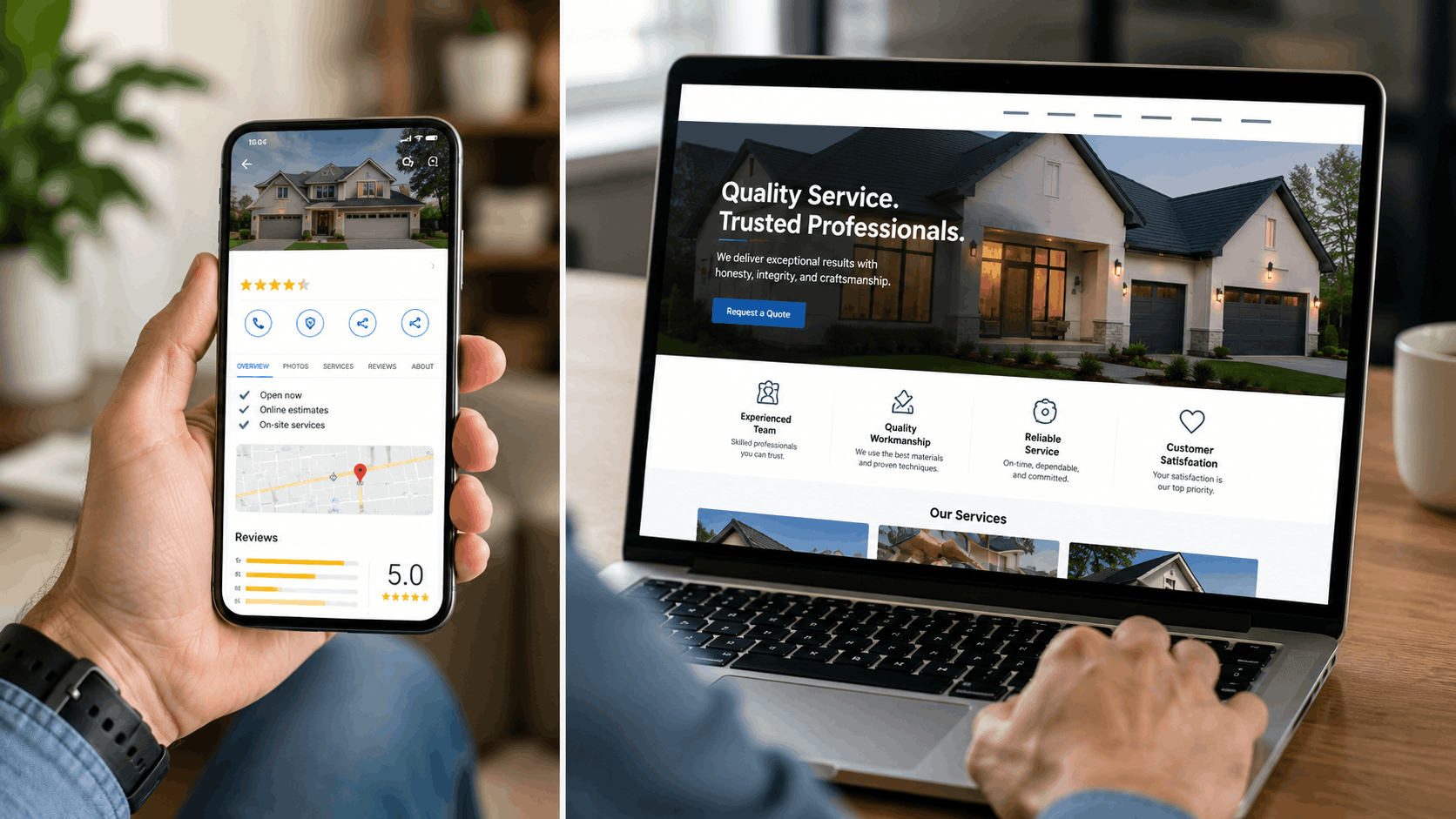
Google Business Profile on mobile beside contractor website on laptop showing reviews

What a Google Business Profile Actually Does for a Local Business

A Google Business Profile - often called GBP - is a free business listing that appears in Google Maps and local search results. Think of it as a digital storefront that Google manages on its own platform. When someone searches for a type of business nearby, Google pulls information from these profiles to show names, addresses, phone numbers, ratings, photos, and hours right inside the search results.

For local businesses, a GBP is often the first impression a customer gets. It shows up before any website link, and it appears directly inside the Google Maps listing that most people check on their phones. Here is a quick breakdown of what GBP offers versus what it cannot do:

What GBP Does WellWhat GBP Cannot Do
Shows up in map pack and local search resultsHost detailed service or pricing pages
Displays reviews, photos, and business hoursCapture leads through forms or booking widgets
Allows Google Posts and Q&AGive you full control over design or branding
Drives phone calls and direction requestsProtect against algorithm changes affecting visibility
  • GBP is free to set up and manage
  • It connects directly to Google Maps for navigation
  • Customers can call, message, or request directions with one tap
  • It displays real-time information like holiday hours or temporary closures

How GBP Shows Up in Map Pack and Local Search

When someone standing on Oak Park Avenue searches "plumber near me" on their phone, Google shows a map pack - a group of three local business listings pinned on a map - before any organic website results appear. This map pack dominates the screen on mobile devices. For many local searches, it is the only thing a customer sees before making a call.

The local search ranking inside this map pack depends on three things: relevance (does the business match the search?), distance (how close is it to the searcher?), and prominence (does Google trust this business based on reviews, activity, and linked web content?). A business with an active, complete GBP has a much better shot at landing in that three-pack.

Near me searches have grown steadily over the past five years, according to Google's own consumer research. People search while sitting in their car, walking through a shopping district, or standing in line at the grocery store. If a business does not have a Google Business Profile - or has one that is incomplete - it simply will not appear in these moments.

Reviews, Photos, and Posts - Your GBP Content Tools

Inside a Google Business Profile, there are several content features that give potential customers a quick snapshot of the business without them ever leaving Google. Each one plays a different role:

  • Google reviews - Customer ratings and written feedback appear right on the listing. A business with 87 five-star reviews and thoughtful owner responses will always win more clicks than one with 4 reviews and no replies.
  • Business photos - Images of the storefront, products, team, and completed work give people a visual preview. Profiles with recent photos get more engagement than those with outdated or stock images.
  • GBP posts - These are short updates similar to social media posts. A bakery can announce a new seasonal menu, a landscaper can share a before-and-after project, or a dentist can promote a teeth-whitening special.
  • Q&A section - Customers can ask questions directly on the listing, and the business owner can answer them publicly. This is a free opportunity to address common concerns before someone picks up the phone.
  • Service menus - Businesses can list their services with short descriptions right on the profile, giving searchers a fast overview of what they offer.

All of these features are visible in the local search results and on the Google Maps listing. They give the business a voice inside Google's own ecosystem.

The Limits of Relying Only on Your Google Profile

Here is the uncomfortable truth about a Google Business Profile: you do not own it. Google controls the layout, the features, and the algorithm that decides whether your listing shows up at all. A business near a downtown district could rank in the top three for months, then drop out of the map pack overnight after a Google algorithm change - and there is no customer service line to call about it.

GBP limitations go beyond algorithm risk. The profile does not allow detailed service pages, long-form content, or custom conversion paths. A roofing company cannot walk a homeowner through financing options on a GBP. A wedding photographer cannot display a full portfolio. The format is rigid, and every competitor's listing looks nearly identical.

There is also the online presence risk of putting all eggs in one basket. Google has shut down features before - remember Google My Business websites? Businesses that relied solely on those free mini-sites lost their web presence when Google discontinued the feature. A GBP is an incredible tool, but it works best when paired with something the business actually owns.

What Your Website Does That a Google Profile Cannot

A local business website fills every gap that a Google Business Profile leaves open. It gives the business full control over branding, messaging, and customer experience. While GBP acts like a billboard on a busy highway, a website is the actual store that people walk into.

The website benefits go deep:

  • Full control over design, layout, and messaging
  • Ability to create pages that target long-tail keywords like "emergency furnace repair in Fairview" or "gluten-free wedding cakes near Brookfield"
  • Conversion tools like contact forms, booking calendars, and email capture
  • Space for portfolios, case studies, testimonials, and detailed pricing
  • A permanent digital address that does not depend on any third-party platform

A local business website is the one piece of digital real estate where the business makes all the rules.

Owning Your Online Real Estate

Think about how shop owners along Main Street in small towns treat their storefronts - the paint, the signage, the window displays. They invest in these details because they own that space. A website deserves the same attention. It is the business's digital property, registered under its own domain, controlled entirely by the owner.

Renting space on Google is useful, but it is still renting. If Google changes its rules tomorrow - adjusts the algorithm, removes a feature, or restructures how local listings display - the business has no say. A website still stands regardless of what Google does. It is the one online asset that no platform can take away.

Brand control matters more than most business owners realize. On GBP, every listing looks the same. On a website, a business can tell its story, show its personality, and guide visitors toward a specific action. That difference is what turns a browser into a buyer.

Detailed Service Pages and Location-Specific Content

A website allows a business to create individual pages for each service and each neighborhood it serves. This is something a GBP simply cannot replicate. A landscaper in the Riverside neighborhood can build a page about drainage solutions specific to that area's clay soil, while also having a separate page for newer subdivisions off Cedar Lane where yard grading is a common request.

These service pages and location-specific pages do double duty. They answer real questions that potential customers are typing into Google - neighborhood-specific content that matches how people actually search. A homeowner does not search "plumber" - they search "fix low water pressure Hillcrest" or "sewer line repair near Maple Ridge."

Each page becomes a doorway into the business. The more specific and useful the content, the more likely Google will show it for the exact search terms that bring in paying customers.

Capturing Leads Beyond a Phone Call

A Google Business Profile gives customers two main ways to reach a business: call or get directions. That covers daytime hours when someone is ready to pick up the phone. But what about the dentist's office near Maple Ridge where a parent discovers a chipped tooth at 11 PM? That parent is not calling anyone - they are looking for a website with an online booking form.

Websites allow contact forms, appointment booking, email signups, and chat widgets. These lead generation tools work around the clock. A home inspector can accept booking requests at midnight. A dog groomer can collect new client intake forms on a Sunday morning. An attorney can offer a free consultation request form that feeds directly into their calendar.

Every one of these online booking and contact form interactions represents a customer that GBP alone would have missed.

Business consultant showing Google Business Profile analytics dashboard on laptop to smiling client

Where Google Business Profile and Your Website Overlap

GBP and a website are not separate islands. They share several data points that both customers and search engines rely on. When these overlapping elements match, they create strong local SEO signals. When they conflict, they create confusion that hurts rankings and frustrates people.

Here is where the two platforms share responsibilities:

Shared ElementOn GBPOn Website
Business NameProfile nameHeader, footer, title tags
AddressListed in profileContact page, footer, schema
Phone NumberClick-to-call buttonHeader, contact page, schema
Business HoursHours sectionContact page or sidebar
Service ListServices sectionIndividual service pages
PhotosPhoto galleryGallery and service pages
Reviews/TestimonialsGoogle reviewsTestimonial section

NAP consistency - making sure the business name, address, and phone number match exactly across every platform - is the foundation that holds this all together.

Matching Your Business Name, Address, and Phone Number

NAP consistency sounds simple, but small mismatches trip up businesses constantly. If the GBP says "Suite 200" but the website says "#200," search engines treat these as potentially different businesses. A law firm on Broad Street with multiple suite numbers might list "305 Broad Street, Suite 4B" on Google but "305 Broad St., Ste. 4B" on the website. To a human, these are the same. To a search engine parsing local citations, they might not be.

This matters because Google cross-references business information across dozens of sources - the GBP, the website, directory listings like Yelp, the Better Business Bureau, and local chamber of commerce pages. Every mismatch weakens the signal. Every exact match strengthens it.

The fix is straightforward: pick one exact format for the business name, address, and phone number, and use that exact format everywhere. Copy and paste it. Do not retype it. Check it on GBP, the website's business information page, and every business directory accuracy listing the business appears on.

Business Hours, Holiday Schedules, and Service Updates

Customers check both GBP and a website for hours - especially during holidays or severe weather. A restaurant on Lakeview Drive that updates its GBP with Thanksgiving hours but forgets to update the website will frustrate the family that drove 20 minutes only to find locked doors. These inconsistencies erode trust fast.

Seasonal changes make this even trickier. An ice cream shop shifts to summer hours in May. An auto repair shop adjusts its Saturday schedule in winter. A tax preparer extends hours from January through April. Each of these changes needs to appear in both places at the same time - on the holiday schedule section of GBP and on the website's contact page.

Consistent information is not just about avoiding bad reviews. It signals to Google that the business is active and well-managed, which supports local rankings.

Trust Signals Customers Look For on Both Platforms

Customers often check a GBP listing first - they scan the star rating, read a couple of online reviews, and look at photos. If they are interested, they click through to the website to confirm their impression. This two-step verification process happens thousands of times a day in every city.

On GBP, customer trust comes from review volume, average rating, and owner responses. On the website, it comes from testimonials, before-and-after photos, certifications, awards, and professional design. Social proof needs to exist in both places. A business with 200 Google reviews but a bare-bones website sends mixed signals. A business with a beautiful website but only 3 reviews on GBP raises questions.

The strongest local businesses display trust signals across both platforms - reviews on Google, professional photos on the site and the listing, and consistent messaging that matches no matter where a customer finds them.

How GBP and Your Website Feed Each Other for Better Local SEO

This is where Google Business Profile and a website stop being separate tools and start working as a team. The technical relationship between the two creates a feedback loop that strengthens local SEO performance for both. Google uses information from the website to better understand the GBP listing, and the GBP listing drives high-quality traffic back to the website.

When both platforms are active, consistent, and well-maintained, they send reinforcing signals to Google's ranking algorithm. This is the "how they work together" core of the strategy, and it is where the biggest gains happen for local businesses willing to invest a little time.

Your Website Link on GBP Sends Qualified Traffic

The GBP website link is one of the most valuable clicks a local business can earn. Think about the customer journey: someone searches for a service, sees a business in the map pack, reads a few Google reviews, checks the hours, and then clicks the website link. That person is not casually browsing. They are comparing their final options and looking for a reason to commit.

This qualified traffic converts at a much higher rate than general web traffic. That is why landing page strategy matters. For a single-location business, pointing the GBP link to a well-built homepage works if the homepage includes clear calls to action, service descriptions, and contact information above the fold. But for a multi-service business - say, an HVAC company that does both residential and commercial work - sending that link to a specific service landing page can increase conversions.

The goal is to match the expectation the customer built on Google with the experience they get when they land on the website.

Website Content That Boosts Your Map Pack Ranking

Publishing relevant, location-specific content on a website sends direct signals to Google about what the business does and where it does it. A plumber who writes about hard water issues common in homes near Hillcrest Elementary or older galvanized pipes in the Fairview district tells Google exactly what neighborhoods this business serves.

This local content does something a GBP listing alone cannot - it creates depth. A single GBP profile might list "drain cleaning" as a service. But a website page titled "Drain Cleaning for Older Homes in the Westside Plaza Area" gives Google hundreds of words of context about the service, the location, and the specific problems customers face there.

According to Moz's Local Search Ranking Factors study, on-site signals like geographic content and domain authority account for a significant portion of what determines map pack ranking. The website and GBP are not competing - the website is feeding the GBP's ability to rank.

Schema Markup and Structured Data - The Behind-the-Scenes Connection

Structured data - specifically LocalBusiness schema - is code placed on a website that tells search engines the business name, address, services, hours, and other details in a format they can read perfectly. Think of it as a cheat sheet that sits inside the website's code, invisible to visitors but crystal clear to Google.

When the structured data on a website matches the information on the GBP listing, it creates a strong, unambiguous signal. Google does not have to guess whether these two sources refer to the same business. The connection is explicit.

Most business owners do not know how to write schema markup, and they should not have to. Platforms like Grow Local build LocalBusiness schema directly into every site, automatically matching the business details entered during setup. This behind-the-scenes connection is one of the biggest technical advantages a purpose-built local website provides.

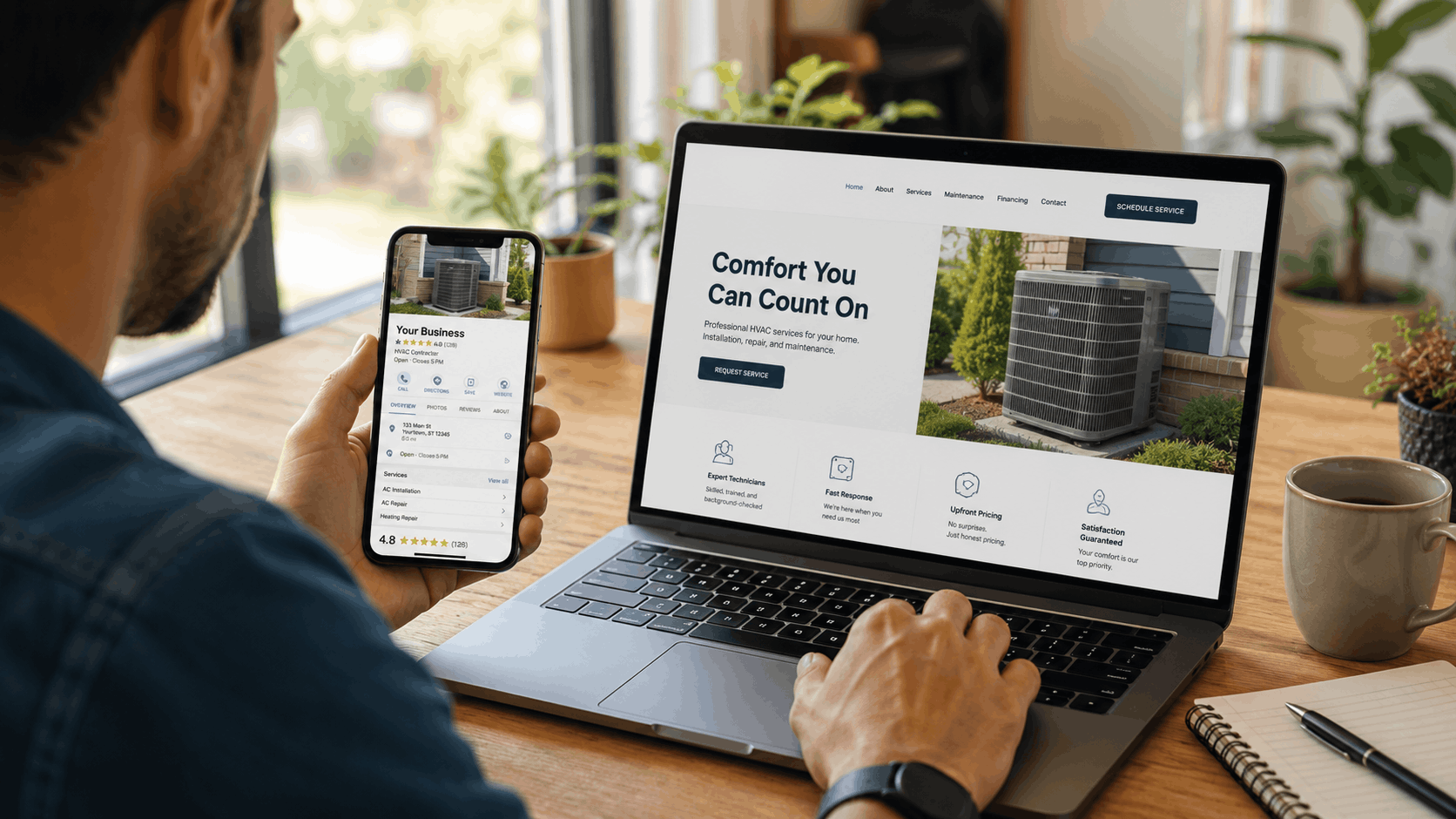
Man reviewing HVAC business Google Business Profile on phone beside professional website on laptop

Common Mistakes Local Businesses Make With GBP and Their Website

Knowing what to do is one thing. Knowing what to avoid is just as useful. These local SEO mistakes show up constantly among small businesses, and each one weakens the connection between a GBP and a website. Fixing them does not require a marketing degree - just awareness and a little consistency.

Setting Up GBP and Then Never Touching It Again

The "set it and forget it" approach is the most common GBP error in local business marketing. A business owner claims the profile, fills in the basics, maybe uploads a photo or two, and walks away. Two years later, the hours are wrong, there are 14 unanswered reviews, and the last GBP post was from a holiday that already passed twice.

Google rewards active profiles. Businesses that post updates, respond to reviews, and upload new photos regularly signal to Google that they are open, engaged, and relevant. An inactive GBP is not just a missed opportunity - it actively loses ground to competitors who are posting weekly.

How often should a business update its profile? At a minimum, respond to every new review within 48 hours, add a new photo at least twice a month, and publish a GBP post once a week. According to Google's own business profile guidelines, keeping information accurate and fresh directly affects how the listing performs. Google profile management is not a one-time task - it is an ongoing habit.

Building a Website With No Local Signals

Some businesses invest in a nice-looking website that never once mentions their city, their neighborhood, or even their state. The site reads like it could belong to any business anywhere in the country. It might say "We offer professional cleaning services" without ever specifying where those services are available.

Without city names, neighborhood references, and geo-targeted content, Google has little reason to connect that website to local searches. A cleaning company serving the Brookfield corridor needs to say so - on the homepage, on service pages, and in page titles. The website should mention the specific areas it covers, the streets it drives, and the community it belongs to.

Local website SEO is not about stuffing city names into every sentence. It is about writing naturally about the places the business actually serves, the way a real person would describe their service area to a neighbor.

Conflicting Information Between Platforms

A business changes its phone number on the website but not on GBP. Or it adds a new service to GBP - say, "emergency weekend repairs" - but the website still shows "Monday through Friday" availability. This conflicting business info creates problems for both customers and search engines.

Businesses with multiple locations near areas like the Brookfield corridor or Westside Plaza run into this more frequently. Each location might have its own GBP listing, and keeping all of them in sync with the corresponding website pages requires a system. A spreadsheet, a monthly review, or a platform that centralizes business information - anything that prevents one location's hours from being two months out of date while others are current.

Information accuracy is the foundation of trust, and trust is the foundation of local SEO. Every mismatch chips away at both.

A Simple Action Plan to Get GBP and Your Website Working Together

Theory is great, but action is better. Here is a practical local SEO action plan that any business owner can follow this week. No agency required. No technical background needed.

Step One - Audit What You Already Have

Open the GBP listing and the business website side by side - literally, two browser tabs. Compare everything: business name, address, phone number, hours, services, photos, and description. Write down every difference, no matter how small. Check for outdated photos, missing service categories, and broken links.

This local SEO audit should take about 20 minutes. Use a simple checklist:

  • Does the business name match exactly?
  • Is the address format identical - same abbreviations, same suite number style?
  • Is the phone number the same on both?
  • Do the listed services match?
  • Are the hours current on both platforms?
  • When was the last GBP post published?
  • When was the last website update?

This GBP audit and website review will reveal exactly where the gaps are before a single change is made.

Step Two - Fill in the Gaps on Both Platforms

Now fix what the audit uncovered. On GBP, add missing services, upload fresh photos taken this month, write a complete business description with location references, and select every relevant category. On the website, create location-specific pages if they do not exist, add or correct the business address and phone number on every page, and make sure the design and layout present the business professionally.

For the technical parts - schema markup, page structure, image compression, mobile responsiveness - platforms like Grow Local handle this automatically during site creation. Business owners can focus on the content while the GBP optimization and local business tools run in the background.

This step might take a few hours spread over a couple of days. Prioritize NAP consistency first, then move on to content and photos.

Step Three - Build a Monthly Maintenance Habit

Ongoing local SEO is not a massive time commitment. About an hour a month keeps both platforms fresh and working together. Here is a simple monthly checklist:

  1. Respond to every new Google review - thank positive reviewers by name and address concerns in negative reviews professionally
  2. Publish at least one GBP post - a project photo, a seasonal tip, a special offer, or a community event
  3. Check hours for any upcoming holidays or schedule changes
  4. Add one new photo to both GBP and the website
  5. Review website analytics through the site dashboard to see which pages get the most traffic and where visitors drop off

This monthly SEO maintenance routine, done consistently, compounds over time. A business that maintains this habit for six months will see a noticeably different local search presence than one that does nothing after the initial setup.

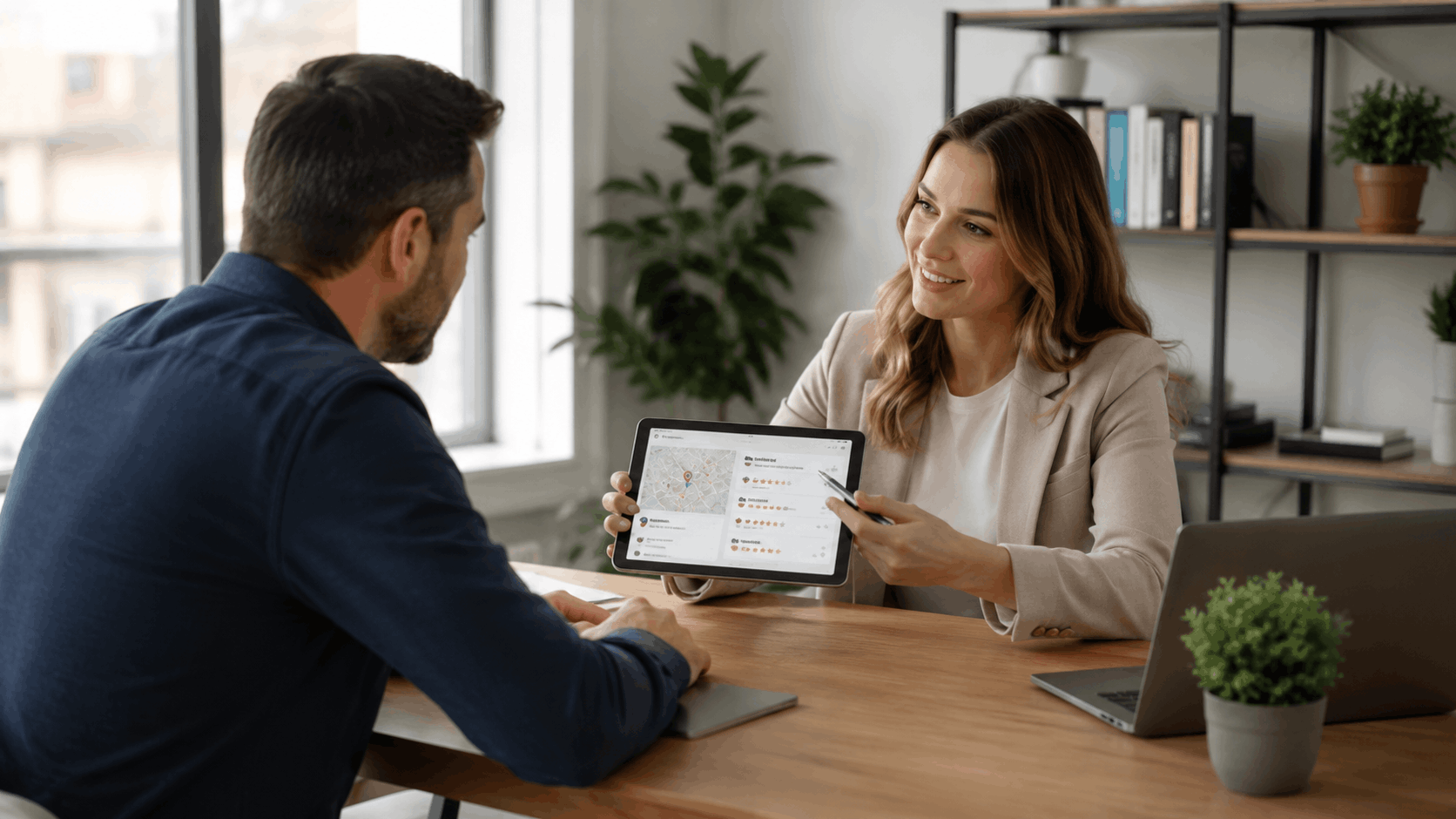
Real estate agent showing local business map listings on tablet to client

Why Fast, Locally Built Websites Give GBP an Extra Edge

Not all websites support a Google Business Profile equally. A slow, bloated site built on a generic template can actually drag down local performance. On the other hand, a fast local website built specifically for local search gives the GBP listing a measurable advantage.

Page Speed and Mobile Performance Matter for Local Search

Most people who click a GBP website link are on their phone. They are sitting in a parking lot near Westside Plaza, standing outside a shop on Broad Street, or scrolling from the couch after dinner. If the website takes more than three seconds to load, a large percentage of those visitors leave before the page even renders.

Google measures Core Web Vitals - page speed, visual stability, and interactivity - as part of its ranking criteria. A mobile-first website that loads in under two seconds sends a strong positive signal. A site that takes five seconds and shifts content around while loading sends the opposite signal.

For local businesses, page speed is not a vanity metric. It directly affects whether a customer who found the business on Google actually sees the website. Every second of delay costs real leads.

How Grow Local Builds Sites That Pair Perfectly With GBP

Grow Local creates websites with built-in local SEO structure from day one. That means proper LocalBusiness schema markup, location pages, fast load times on mobile devices, and clean design that matches what GBP visitors expect when they click through.

The sites are built specifically for local businesses - not adapted from generic templates. The business information entered during setup flows into the schema, the footer, the contact page, and every other place search engines look for it. There is no need to hire a developer to add structured data or manually code location pages.

For a business owner who wants both their Google Business Profile and their website working together without spending weeks learning technical SEO, Grow Local is built for exactly that situation. The AI-powered builder handles the technical foundation so the business owner can focus on serving customers.

Final Thoughts

A Google Business Profile and a website are not competing tools - they are two halves of the same local marketing strategy. GBP puts a business on the map and gives searchers a fast first impression. The website fills in the details, captures leads around the clock, and gives the business a permanent home online that no platform change can take away.

The businesses that show up most consistently in local search are the ones that keep both platforms active, accurate, and aligned. It does not take a big budget or a marketing team. It takes attention, consistency, and the right tools. If getting both platforms working together sounds like the right next step, start building a site that supports the local presence at www.growlocal.build.

Two colleagues smiling while reviewing FAQ answers together on a laptop in office

Frequently Asked Questions

Do I really need a website if I already have a Google Business Profile?

Yes. A GBP gets attention in search results, but a website closes the deal. Without a site, there is nowhere for customers to browse detailed pricing, see a full portfolio, or book an appointment after hours. Businesses with both a GBP and a website convert more searchers into actual customers because the website provides the depth and conversion paths that a profile listing simply cannot offer on its own.

Can a Google Business Profile rank without a website?

Technically, a GBP can appear in local results without a linked website. However, it is harder to rank well. Google uses website content as a ranking signal for GBP listings - things like location-specific pages, domain authority, and structured data all contribute. Businesses without a website are at a clear disadvantage against competitors who have one, especially in areas with moderate to high competition.

How often should I update my Google Business Profile?

At least once a week is a good target. This could be a new Google Post, a fresh photo, or a response to a recent review. Monthly at minimum, check that hours and service descriptions are current, especially around holidays or seasonal schedule changes. Active profiles tend to rank higher in local results because Google interprets regular activity as a sign the business is engaged and relevant.

What should the website link on my GBP point to?

For single-location businesses with a well-structured homepage, the homepage usually works. It should include clear service descriptions, contact information, and a call to action above the fold. For multi-service or multi-location businesses, consider pointing the GBP website URL to a specific landing page that matches the primary GBP category - this creates a tighter match between what the searcher expects and what they see.

Does having a faster website help my Google Business Profile show up more?

Indirectly, yes. Google considers website quality - including page speed, mobile-friendliness, and Core Web Vitals - when evaluating the overall GBP ranking factors for a business. A fast, mobile-friendly site sends positive quality signals that can support higher placement in the map pack. A slow site that frustrates visitors works against the listing's performance in local search.

What is NAP consistency and why does it matter?

NAP stands for Name, Address, Phone number. When this information matches exactly across a GBP listing, the business website, and other online directories, search engines have more confidence displaying the business in local results. Even small differences - like "Street" versus "St." or a missing suite number - can weaken local citations and make it harder for Google to confirm the business is legitimate and active.

Should I use Google's free website builder or a separate platform?

Google's built-in website builder has been discontinued, so it is no longer an option. Even when it was available, it offered very limited customization and no real SEO structure. A dedicated local website builder like Grow Local provides far more control over design, better SEO structure with built-in schema markup, and a more professional appearance that converts visitors into leads.

How do reviews on GBP and my website work together?

Google reviews build trust directly in search results and influence map rankings through volume, quality, and recency. Displaying those same reviews or other testimonials on the website reinforces trust when someone clicks through from the listing. Both platforms benefit from a steady flow of genuine customer feedback. A strong review strategy targets Google for search visibility and the website for conversion confidence.

What is schema markup and do I need it on my website?

Schema markup is structured data - a small piece of code embedded in a website that tells search engines specific details about the business in a standardized format. It helps Google connect the website to the GBP listing and verify business information. Most local businesses benefit significantly from having it. Platforms like Grow Local add LocalBusiness schema automatically, so business owners do not need to write any code themselves.

How long does it take to see results from using GBP and a website together?

Most local businesses start seeing improvements in search visibility within 4 to 12 weeks of getting both platforms aligned and consistently maintained. The local SEO timeline depends on competition in the area, the quality and specificity of website content, review activity, and how often both platforms are updated. Businesses in less competitive niches may see faster movement, while those in crowded markets may need closer to three months.

Grow Local Team

Written by Grow Local Team

Editorial

Grow Local helps local service businesses build SEO-ready sites and grow online.

Ready to improve your local visibility?

Get started now and discover local opportunities you're missing.

Get Started Now

Pay $99/mo when you go live • Cancel anytime