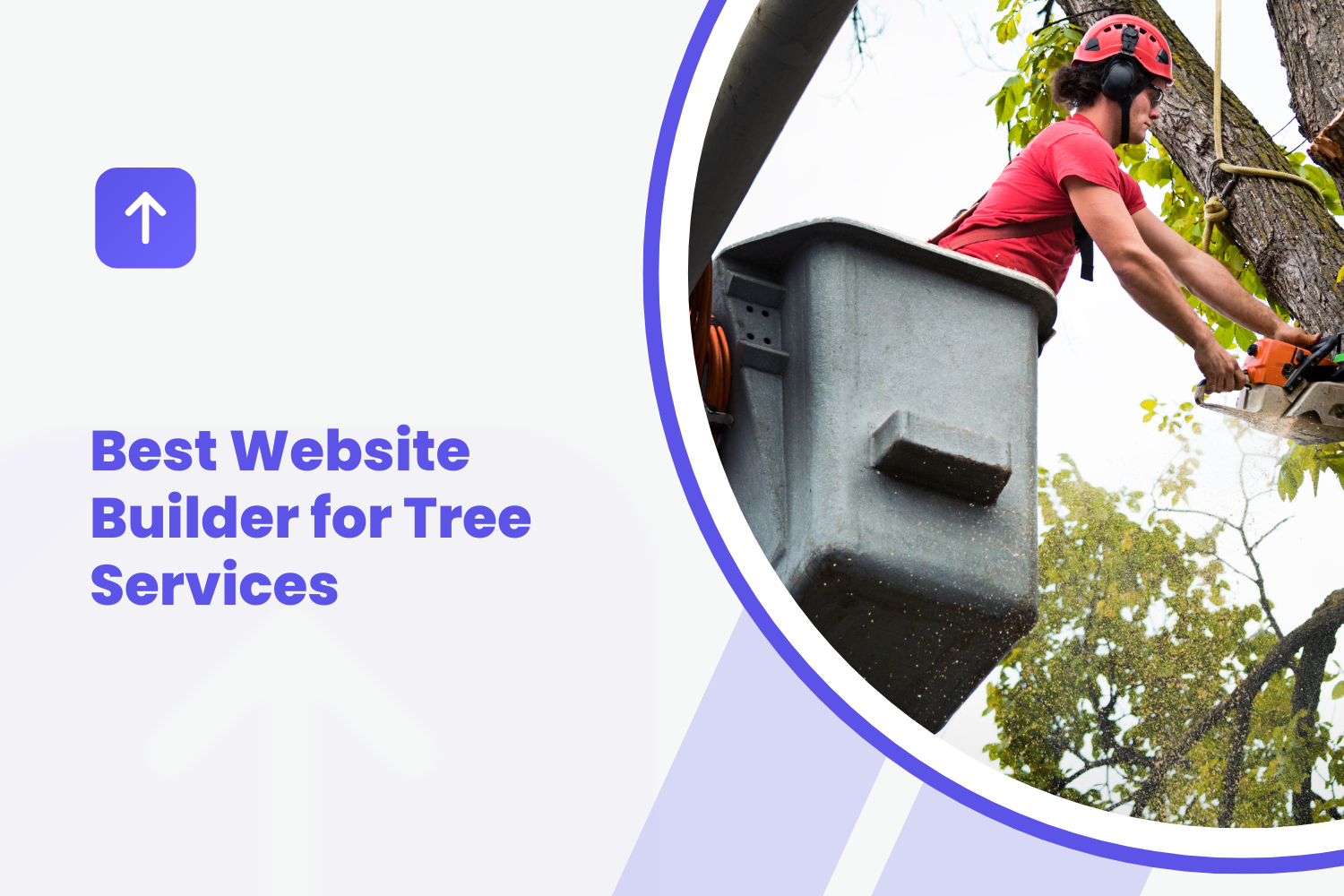
Short answer: the best website builder for a tree service is the one that gets a complete local site live and makes it easy for a worried homeowner to call you. Good tree service web development comes down to a few things: a tappable phone number on every screen, a page for each service (removal, trimming and pruning, emergency and storm work, stump grinding, land clearing, plant health care if you offer it), a page for each main town you serve, real photos of your crew and equipment, clear proof of insurance and credentials, recent reviews and business details that match your Google Business Profile. Wix and Squarespace start around $17 and $19 a month billed annually and give you design freedom, but you write every page. WordPress gives the most control and the most upkeep. An agency builds it for you at a higher cost. Grow Local's tree service website builder writes the service and town pages from your answers for $99 a month, with less design flexibility. This guide covers what a tree service site needs to do, local SEO for tree companies, how the main options compare and how to get your site ready to bring in work.
Key Takeaways
- 1A tree service website must serve urgent storm customers and planned customers, with a tappable phone number on every page and a clear emergency page.
- 2Build a page for each service (removal, trimming, emergency, stump grinding, land clearing) and each main town, with real local detail.
- 3Show insurance status accurately and list only credentials you actually hold, such as ISA Certified Arborist or TCIA Accreditation.
- 4Real photos of crews, equipment and clean job sites, plus recent reviews, build trust for high-stakes work.
- 5Wix and Squarespace start around $17 and $19 a month billed annually but you write every page; Grow Local writes the service and town pages for $99 a month with no contract.
- 6Keep your Google Business Profile accurate and update your site quickly after storms with your real availability.
- 01What a Tree Service Website Really Needs to Do
- 02Local SEO for Tree Service Companies
- 03Phone-Friendly Pages for On-the-Go Customers
- 04Comparing Website Builder Options for Tree Companies
- 05Features to Look for Before You Commit
- 06Pages Every Tree Service Site Should Have
- 07Getting Your Tree Service Site Ready to Bring in Leads
- 08Seasons and Storms
- 09Earning Local Links and Mentions
- 10Three Example Tree Service Businesses
- 11Myths About Tree Service Websites
- 12Common Tree Service Website Mistakes
- 13Using Google Business Profile Features Well
- 14Turning Calls Into Booked Jobs
- 15Questions to Ask Before Choosing a Builder or Provider
- 16Hidden Costs to Watch For
- 17Switching From Your Current Website
- 18A 90-Day Plan
- 19A Monthly Routine
- 20Phone Checklist
- 21How AI Search Fits In
- 22Frequently Asked Questions
- 23Final Thoughts
What a Tree Service Website Really Needs to Do
A tree service website has two very different audiences. One has an urgent problem: a limb on the roof after a storm, a tree leaning toward the house, a trunk across the driveway. The other is planning: a dead tree they have been meaning to remove, overgrown branches over the roof, a lot to clear before building, a yearly pruning schedule. Your site needs to serve both.
Turning urgent calls into booked jobs
Storm and emergency customers search on their phones, often stressed and sometimes without power. BrightLocal's 2026 data found 73% of local searches start on a mobile device. Put a tappable phone number at the top of every page, a clear emergency section on your homepage and accurate hours. If you offer after-hours emergency service, say so plainly. If you do not, say what callers should do. Never advertise availability or response times you cannot deliver, especially after a big storm when every tree company is booked.
Serving planned customers
Planned customers compare. They read service pages, look at photos, check reviews and want to understand pricing and process. Detailed pages, honest pricing information and real project photos win these jobs, which are often larger and more profitable than emergency calls.
Showing off real job photos and reviews
Tree work is visual and high-stakes. Homeowners want to see that you can take down a large tree near a house without damage. Nielsen Norman Group's eyetracking research found users ignore generic stock photos but look closely at real ones. Show your crew, bucket trucks, cranes and chippers, before-and-after shots and clean job sites. BrightLocal's 2026 survey found 47% of consumers won't use a business with fewer than 20 reviews, 74% want reviews from the past three months and 54% visit a business's website after reading positive reviews.
Proving insurance, credentials and safety up front
Tree work is dangerous, and homeowners know it. Many worry about who is liable if something goes wrong. Make trust details easy to find:
- Your insurance status, stated accurately, and whether you provide certificates of insurance on request.
- Credentials you actually hold, such as ISA Certified Arborist status for team members or TCIA Accreditation for the company.
- Any state or local license your area requires for tree work.
- Your safety practices and the equipment you use.
- How you protect lawns, driveways, landscaping and structures.
Only list credentials you actually hold, and keep them current. Claiming certifications you do not have can break consumer protection laws and lose customer trust fast.
Explaining pricing honestly
An older BrightLocal survey from 2016 found consumers of every age group named prices among the must-haves on a local business site. Tree work is hard to price without seeing the job, so explain what affects cost: tree size and species, location and access, proximity to structures and power lines, whether a crane is needed, stump grinding, debris haul-away and permits. Say whether estimates are free and how you confirm the final price.
Local SEO for Tree Service Companies
An unseen website books nothing. Local SEO for tree services comes down to your Google Business Profile and your website working together.
Google Business Profile
Google names relevance, distance and prominence as the main local ranking factors, says businesses "with complete and accurate info are more likely to show up in local search results," and says there is "no way to request or pay for a better local ranking on Google," according to its help page on local ranking. For tree companies:
- Verify your profile and choose the most accurate primary category, such as "Tree service."
- Add secondary categories only for services you actually provide.
- Most tree companies are service-area businesses. Hide your address if customers do not visit it and list the areas you serve, as Google's guidelines describe.
- Keep hours accurate, including emergency availability if you offer it.
- Add real photos of crews, equipment and finished jobs.
- Ask every customer for a review and reply to every review.
- Use your real business name. Google's guidelines for representing your business say adding extra words such as keywords or towns to your name is not permitted and can lead to suspension.
Service pages that match what people type
Customers search by service and problem, not by "arboricultural solutions." Give each main service its own page:
- Tree removal, including hazardous and large tree removal
- Tree trimming and pruning
- Emergency and storm damage tree service
- Stump grinding and stump removal
- Land and lot clearing
- Crown reduction, thinning and cabling or bracing, if you offer them
- Tree health assessments and plant health care, if you have the expertise
- Commercial and HOA tree services
- Firewood or wood chip delivery, if you sell them
Each page should explain the service, when it is needed, how the job works, safety and cleanup, what affects price and the areas you cover. Google's SEO Starter Guide asks for content that is "helpful, reliable, and people-first" and titles that are unique to each page.
Town pages for the areas you serve
Town pages help you show up when someone searches with a town name. Write each with real local detail: neighborhoods, common tree species in the area, local permit rules if a town requires permits for removal, typical problems such as older oaks over historic homes or pines that snap in ice storms, and recent jobs nearby. Google's spam policies treat near-identical pages that only swap the town name as doorway pages, so avoid copy-and-paste pages.
Using the words customers use
Homeowners say "tree cutting," "tree trimming," "cut down a tree" and "stump removal" as often as "arborist" or "crown reduction." Use both plain and technical terms naturally, and explain the technical ones. Google says to "think about the words that a user might search for." Check Google's autocomplete, the "People also ask" questions and, once your site is live, Google Search Console to see the actual searches that show your pages.
Site structure search engines understand
Keep it simple: homepage, a page for each service, a page for each main town, an emergency page, an about page with your credentials, a gallery, a pricing or "how estimates work" page and a contact page. Link your homepage to every service and town page, link service pages to the towns you serve and use readable web addresses such as /tree-removal and /tree-service-henrico.
Consistent business details
Your business name, phone number and service area should match on your website, Google Business Profile, Apple Business, Bing Places, Yelp, Nextdoor and any directories. Structured data can help describe your business to search engines; Google's LocalBusiness documentation requires only name and address, and it must match what is visible on your page. It is not a ranking shortcut.
Phone-Friendly Pages for On-the-Go Customers
One-tap calling and quote requests
Your phone number should be a tappable link in the header of every page, repeated after each section and ideally in a call bar that stays visible on phones. Add a short quote form for planned work: name, phone, address, what needs doing and a photo upload. A HubSpot analysis of more than 40,000 landing pages found conversion rates fall as form fields are added, so keep it short. A photo of the tree often lets you give a rough range before visiting.
Photos that look good without slowing pages
Tree work photos are often large, high-resolution shots from your phone. Resize them before uploading so pages stay light on a cellular connection, and use descriptive file names and alt text, such as "crane removal of large oak near house in Henrico." Google says these help it understand images, according to its image guidelines. You do not need to chase speed scores. Just avoid giant files, auto-playing video and unnecessary add-ons, and test your site on your own phone outdoors.
Photo tips for tree crews
- Take a "before" shot from the street or yard before you start, and an "after" from the same spot.
- Capture the hard parts: rigging over a roof, a crane lift, a climber at work with proper safety gear.
- Show cleanup: raked lawns, swept driveways, ground stumps.
- Photograph your trucks and equipment clean, with your logo visible.
- Avoid photos that show unsafe practices, customers' faces or house numbers without permission.
- Shoot in daylight when you can, and keep the phone steady.
A steady stream of good photos does more for trust than any amount of marketing copy.
Work near power lines
Many homeowners do not know that trees touching or near power lines often need special handling. If your crew is qualified for line-clearance work, say so and explain what that means. If not, explain that you coordinate with the utility or that customers should contact their utility first. Clear, honest information on this protects customers and positions you as the careful professional.
Comparing Website Builder Options for Tree Companies
We compared the main options using each vendor's published information. We did not run our own speed or ranking tests, and no platform can guarantee rankings or calls. Prices are as listed in September and October 2026 and change often, so check current pricing. Grow Local is our own product, so we describe its limits as plainly as its strengths.
General drag-and-drop builders: Wix and Squarespace
Wix gives the most design freedom, with drag-and-drop editing and an app market for forms, reviews, chat and booking. Wix lists paid plans from $17 to $159 a month billed annually, according to Website Builder Expert in September 2026. Squarespace offers polished templates that make big tree photos look good, and Squarespace lists its Basic plan at $19 a month billed annually or $25 monthly.
Both handle the technical basics: page titles, descriptions, custom domains and HTTPS. Neither builds your local structure. You plan, write and lay out every service and town page. Apps can add monthly fees, and Wix says its sites cannot be exported to another host.
WordPress
WordPress.com lists hosted plans from $4 a month to $25 for Business, billed yearly, and self-hosted WordPress needs separate hosting, a theme and plugins. It offers the most control and the most upkeep. It suits larger tree companies with a developer or a tech-comfortable office manager.
Hiring a freelancer or agency
An agency or freelancer builds a custom site and usually writes the content. A GoodFirms survey of more than 200 agencies and freelancers put a basic-feature site at about $3,200 on average, and many charge monthly for hosting and changes. Builds usually take weeks or months. Ask who owns the site and domain and how quickly changes get made, especially during storm season when you may need to update your message fast.
AI-powered builders made for local businesses
Some newer builders use AI to write pages from your answers. Quality varies widely. Check whether you get real service and town pages, whether you can edit them and what is included.
Grow Local is a website builder for local business owners with no technical skills, and tree service is one of the 104 industries it supports. You answer simple questions about your services, the towns you serve, your hours and branding, and AI builds 50 or more pages, including service pages and a location page for each town. A preview builds while you answer, and after payment the full site is usually ready within a few minutes. It includes hosting, SSL, backups, a custom domain, a mobile-responsive design and a Google Business Profile connection. The dashboard lets you update services, hours, phone and photos, shows call clicks and form leads and offers PDF SEO reports. It costs $99 a month on one plan, with no contract and no setup fee, and you can preview the full site free before paying.
Its limits: less design freedom than Wix or Squarespace, a higher monthly price than entry DIY plans, no online booking as a listed feature, no call recording and no guarantees on rankings or leads. You still supply photos and should review AI-written pages for accuracy, especially credentials, insurance details and the services you offer.
Side by side
| Wix / Squarespace | WordPress | Grow Local | Freelancer or agency | |
|---|---|---|---|---|
| Listed price | $17 - $159/month (Wix), from $19/month (Squarespace), billed annually | $4 - $25/month on WordPress.com, billed yearly, plus extras | $99/month, one plan, no contract | About $3,200 average for a basic site, plus monthly fees |
| Service and town pages | You build and write | You or a developer | Written for you | Usually written for you |
| Time to launch | Days to weeks | Days to weeks | Preview while you answer, full site usually within minutes of payment | Weeks to months |
| Google Business Profile connection | Link manually | Link manually or plugin | Built in | Varies |
| Design freedom | High | Highest | Limited | High |
| Ranking guarantees | None | None | None | None, and be wary of any that promise them |
Matching the option to your budget and time
On listed price, DIY builders are cheapest. Once you count the hours to write and maintain fifteen to thirty tree service pages, the comparison depends on what your time is worth. A single large removal can cover months of any of these options. If you enjoy writing and have an office manager, a general builder can work well. If you are on a climbing rope all day and quoting at night, choose an option that writes the pages for you or pay someone who will.
Features to Look for Before You Commit
Easy editing you can do yourself
After a big storm, you may need to change your homepage message within the hour: "We're booked for emergency work through Thursday" or "Taking emergency calls now." Make sure you can update hours, messages and photos from your phone in a few minutes.
Built-in lead forms and quote requests
Forms should work on phones, accept photo uploads and send you a notification you will actually see. Test them before launch.
Local SEO basics
Look for easy control over page titles and descriptions, readable web addresses, the ability to create separate service and town pages and a simple way to connect your Google Business Profile.
Reliable hosting and security
Hosting, SSL and backups should be included or easy to set up. A site that goes down during storm season costs calls.
Ownership
Register your domain in your own name. Know what happens to your site and domain if you cancel.
Pages Every Tree Service Site Should Have
An emergency and storm damage page
This page is often the one that rings your phone at 6 a.m. after a storm. Make it calm, clear and specific:
- A direct opening: what emergency tree work you handle, the areas you cover and how to reach you, with a large tappable phone number.
- Availability: your real emergency hours, stated honestly.
- Safety first: tell people to stay away from downed power lines and call the utility, never to try cutting trees resting on wires and to keep children and pets away from damaged trees.
- What happens next: how you assess the situation, make the area safe, remove the tree and clean up.
- Insurance: if you work with homeowners and their insurers, explain what documentation you provide, such as photos and itemized invoices. Do not promise that insurance will cover anything; that is between the homeowner and their insurer.
- Photos of real storm jobs and reviews from emergency customers.
A tree removal page
Cover when removal makes sense versus pruning, how you remove trees near structures, whether you use cranes or rigging, stump options, permits where your local rules require them, cleanup and what affects price.
A trimming and pruning page
Explain the reasons to prune, such as clearance from roofs and lines, safety, health and shape, how often trees typically need it and your approach. Many arborists follow ANSI A300 pruning standards and avoid topping, which the International Society of Arboriculture discourages. If you follow those practices, say so in plain words; it sets you apart from crews that hack trees.
A town page template
- Heading: "Tree Service in Chesterfield, Virginia."
- Opening: what you do there, typical scheduling and how to reach you.
- Neighborhoods you serve regularly.
- Local tree details: common species, typical problems and any local permit requirements you know apply.
- Services most requested there, linking to each service page.
- A recent job with photos.
- Reviews from customers in that town.
- A call to action with a tappable phone number and short form.
Stump grinding and land clearing pages
Stump grinding is searched on its own, often by people who removed a tree themselves or had another company do it. Explain how deep you grind, what happens to the grindings, whether you fill and seed the area, how you handle roots and what affects price, such as stump diameter, access and number of stumps. A land clearing page should cover lot sizes you handle, equipment such as forestry mulchers, what happens to debris, permits where required and how you protect trees the owner wants to keep.
Tree health and expertise content
If your team includes certified arborists, show that expertise. A page on tree health assessments can explain signs of decline, such as dead branches, fungus at the base, cracks or leaning, and what an assessment involves. Short guides on common local pests and diseases, written accurately and in plain words, attract homeowners who want advice before deciding on removal. Be careful not to diagnose from a distance or overstate certainty; invite people to book an assessment instead.
A homepage that serves both urgent and planned customers
Lay out your homepage so both groups find what they need in seconds:
- Top: what you do and where, a tappable phone number and a short quote button.
- Emergency strip: one line about emergency availability with a link to the emergency page.
- Services: short cards linking to each service page.
- Trust: insurance, credentials and a few recent reviews.
- Photos: three to six of your best before-and-after shots.
- Areas served: links to each town page.
- How estimates work and a final call to action.
An about page with credentials
Tell homeowners who you are: the owner's background, how long you have been in tree work, your team's credentials, your equipment, your insurance status and your safety approach. Add a photo of the crew. People are inviting you to work with chainsaws near their house; they want to know who you are.
Commercial, HOA and property management pages
If you serve businesses, homeowners associations, property managers, churches, schools or municipalities, give that work its own page. These customers care about scheduling, insurance certificates, recurring maintenance, invoicing and how you handle work near people and vehicles. Include photos of commercial jobs and a form asking for property address and type.
Getting Your Tree Service Site Ready to Bring in Leads
Gathering photos, reviews and service details
Before you build, collect:
- Your best 20 to 40 photos: crews at work, equipment, before-and-after shots and clean job sites.
- Your list of services, and which you want to be found for most.
- The towns and neighborhoods you serve.
- Credentials, insurance details and any licenses, exactly as they should appear.
- A few recent reviews you can quote, with permission or from public profiles.
- Your pricing approach and how estimates work.
Writing pages that answer real questions
Write down the questions customers ask on the phone: Is this tree dangerous? Do I need a permit? Will you damage my lawn? How long will it take? Do you grind the stump? What do you do with the wood? Each answer belongs on a service page or in an FAQ section. Put a short direct answer at the top of each page, then go into detail.
Tracking calls and improving over time
Set up Google Search Console to see which searches show your pages and how often people click. Check your Business Profile insights for calls and website clicks. Track call clicks and form submissions from your site, and ask every new customer how they found you. Keep a simple log of date, source, service, town and whether it booked. After a season, you will know which services and towns bring work and which pages need attention.
Seasons and Storms
Tree work demand shifts with the weather and the calendar in many areas. Storms bring urgent removals and cleanup. Late fall and winter are often good times for pruning and removal once leaves drop. Spring brings questions about tree health and new growth. Update your homepage message and add a short seasonal guide before each busy period, such as preparing trees for storm season or signs a tree may be failing. After a major storm, update your site and Business Profile quickly with your real availability.
Earning Local Links and Mentions
Links from other local websites help show that you are an established local business. Good sources for tree companies include your chamber of commerce, landscapers and hardscapers you refer work to, roofers and builders who need trees cleared, real estate agents, property managers, HOAs, local garden clubs, sponsorships of community events and local news coverage of storm cleanup or community work. Google's spam policies describe buying links that pass ranking credit as link spam, so avoid cheap backlink packages.
Three Example Tree Service Businesses
A two-person crew outside Richmond
An owner-operator and one climber serve Henrico, Chesterfield and Mechanicsville. They have a Google Business Profile with 22 reviews and no website. The owner has no time to write. A builder that writes service and town pages from his answers gets a complete site live in an evening, and he spends his time adding job photos and asking every customer for a review.
A certified arborist company near Pittsburgh
A company with two ISA Certified Arborists focuses on pruning, health assessments and preservation rather than removals. The owner enjoys writing, so she builds on Squarespace and writes detailed guides on pruning practices and signs of tree disease, linked to her service pages. Those guides attract planned customers who value expertise over the lowest price.
A large removal and land clearing operation
A company with cranes, forestry mulchers and a commercial division hires an agency for a custom site with separate pages for residential, commercial and land clearing work, and makes sure it owns the domain and content.
Each made a sensible choice. None of them can skip real photos, honest credentials, recent reviews and an accurate Business Profile.
Myths About Tree Service Websites
"Storm calls come from word of mouth, not websites"
Many do, but plenty of people search on their phones when a tree comes down, especially new residents. Your site and profile catch the calls word of mouth misses.
"Design is what matters most"
Clear service and town pages, a tappable phone number, real photos and reviews matter more than design. A plain site that answers questions fast often outperforms a fancy one.
"Keywords in my business name will help me rank"
Adding keywords or towns to your Google business name breaks Google's guidelines and can get your profile suspended.
"An AI-written site will rank automatically"
AI can write pages quickly, but rankings still depend on your Business Profile, reviews, links and competition. No one can guarantee them.
"Listing certifications doesn't matter to homeowners"
For dangerous, expensive work near their homes, many homeowners look for proof of insurance and expertise. Show credentials you actually hold.
Common Tree Service Website Mistakes
- A phone number that is not tappable or only appears in the footer.
- One "services" page instead of a page per service.
- No town names, or copied town pages.
- Stock photos of trees instead of your crew and jobs.
- Vague or missing insurance information.
- Claiming credentials you do not hold.
- Advertising 24/7 emergency service you cannot deliver after a big storm.
- Hours that differ between the website and the Business Profile.
- Huge photo files that make pages slow on phones.
Using Google Business Profile Features Well
Your profile and your website should support each other. Link the profile to your homepage or most relevant page. List each service in the profile with a short description that matches your service page. Add photos regularly, since Google suggests photos and videos to show customers what you offer; crane lifts and clean job sites make strong profile photos. Post updates after storms with your real availability, and when you add equipment or services. Answer common questions, like whether you grind stumps or haul away wood, in the same words on your profile and your site.
Turning Calls Into Booked Jobs
The website gets the call. What happens next decides whether you get the job. Answer quickly or call back within minutes, because storm customers often call several companies. For planned work, offer to give a rough range from photos before a site visit, then confirm on site. Show up when you say you will for estimates, since reliability is a common complaint in tree service reviews. Send written estimates that list exactly what is included, such as stump grinding, debris removal and cleanup. Keep a simple log of each lead and whether it booked.
Questions to Ask Before Choosing a Builder or Provider
- Who writes the service and town pages, and can I edit them?
- Who owns the domain and the site if I leave?
- What is included in the monthly price, and what costs extra?
- How fast can I update my homepage message after a storm?
- Does anyone promise rankings? (Be cautious if they do. Google says no one can pay for better local ranking.)
- How will I see calls and form leads from the site?
Hidden Costs to Watch For
- Domains that are free only for the first year.
- Paid apps or plugins for forms, galleries and reviews.
- Introductory prices that rise at renewal.
- Agency fees for small changes, including storm-season updates.
- Sites that cannot be exported, so leaving means rebuilding.
- Domains registered in someone else's name.
Switching From Your Current Website
If you already have a site, you can move to a new builder without starting over. Make sure you own your domain. List every page on your current site and its web address. On the new site, keep the same addresses where you can, or set up redirects from old addresses to new ones. Keep your name and phone identical, update your Google Business Profile link if needed and check Search Console for errors in the weeks after the switch. Avoid switching right before storm season if you can, since rankings can move while Google processes the change.
A 90-Day Plan
- Weeks 1 and 2: verify and complete your Google Business Profile, fix your business name if needed, match your details everywhere and set up Search Console.
- Weeks 3 to 6: publish a page for each main service and town, an emergency page and an about page with credentials, using your best photos.
- Weeks 7 to 12: ask every customer for a review, add a gallery and one or two helpful guides, and reach out to two landscapers, roofers or property managers.
- Every month after: add photos, reply to reviews, check details and look at Search Console for pages that need work.
A Monthly Routine
- Add three to five new job photos to your site and Business Profile.
- Ask every customer for a review and reply to every review.
- Check hours, phone and service areas on every listing.
- Update your seasonal or storm message.
- Look at Search Console for pages with impressions but few clicks, and improve those titles.
Phone Checklist
- Tappable phone number on every page, tested on your own phone.
- Quote form with photo upload that works on a phone.
- Text readable outdoors without zooming.
- Buttons big enough to tap with a gloved thumb.
- Photos resized for fast loading, with descriptive alt text.
How AI Search Fits In
More homeowners ask AI tools for recommendations. Google says its AI features draw on pages already in Google Search and that there are no special requirements beyond normal SEO, according to its guide to AI features. Yext's analysis of 6.8 million AI citations, vendor research from 2025, found first-party websites were the largest single source at 44%. Clear service and town pages, accurate credentials and real reviews help in both traditional and AI search.
Frequently Asked Questions
What is the best website builder for a tree service company?
It depends on your time and goals. Grow Local suits owners who want service and town pages written for them. Wix and Squarespace suit owners who enjoy design and writing. WordPress suits companies with a developer. An agency suits companies that want a custom site.
What does tree service web development cost?
Listed prices run from about $4 to $25 a month on WordPress.com, $17 to $159 on Wix billed annually, from $19 on Squarespace billed annually and $99 a month for Grow Local. A GoodFirms survey put a basic agency-built site at about $3,200 on average.
Do I need coding skills?
No. Wix, Squarespace and Grow Local require no coding. WordPress is easier with some technical comfort or a developer.
How long does it take to launch a tree service website?
DIY sites take days to weeks depending on how much you write. Agency builds take weeks to months. On Grow Local, the preview builds while you answer and the full site is usually ready within a few minutes of payment.
Will a new website help me rank on Google?
A clear site with service and town pages helps, along with a complete Business Profile, reviews and consistent details. Google says changes can take a few hours to several months to show up, and no one can guarantee rankings.
What pages should a tree service website include?
A homepage, a page for each main service, an emergency page, a page for each main town, an about page with credentials, a gallery, a pricing or estimates page and a contact page.
How do I get more emergency storm calls from my website?
Put a tappable phone number at the top of every page, build a clear emergency page, keep your hours and availability accurate and update your site and Business Profile quickly after storms.
Can I update the website myself?
On most builders, yes. Make sure you can change messages, hours and photos from your phone in minutes.
Is hosting included?
Wix, Squarespace, WordPress.com plans and Grow Local include hosting. Self-hosted WordPress needs separate hosting.
Should I list prices on my tree service website?
Most tree jobs need to be seen before a firm price, but you can explain what affects cost, share typical ranges if you are comfortable and say whether estimates are free. Honest pricing information builds trust and filters out poor-fit calls.
Do I need separate pages for residential and commercial work?
If you do both, yes. Commercial customers, HOAs and property managers care about insurance certificates, scheduling and invoicing, which deserve their own page.
Should I mention local tree removal permits?
If towns you serve require permits to remove certain trees, a short note on the town page or removal page helps customers and shows you know the area. Keep it accurate and suggest customers confirm with their town, since rules change and vary by tree size, species and location.
How do I show customers I am insured and credentialed?
State your insurance status accurately, offer certificates of insurance on request and list only credentials your team actually holds, on your about page and near your phone number.
Final Thoughts
The best website for a tree service is one that earns trust fast and makes calling easy: a tappable phone number on every page, a page for each service and town, real photos of your crew and equipment, honest insurance and credential details, recent reviews and accurate business information everywhere. Wix and Squarespace give you design freedom and leave the writing to you. WordPress gives control and upkeep. Agencies do it for a larger budget. If you would rather spend your time in the trees, the Grow Local tree service website builder writes the pages for you, and you can preview your full site free before paying anything.