Short answer: AI tools like ChatGPT, Perplexity and Gemini find local businesses mostly by reading the same public information people use: your website, your Google Business Profile and other listings, review sites, directories and news or community mentions. When they search the web live, they look for pages that clearly match the question and the location, and they often show links to their sources. None of them sells placement in their answers, and none publishes a full formula. What helps you show up is plain and practical: a website that states what you do and where in clear words, a page for each service and town you serve, a complete and accurate Google Business Profile, matching details on Apple Business, Bing Places and the directories that matter in your field, steady genuine reviews and nothing blocking AI search crawlers from your site. This is sometimes called generative engine optimization, or GEO, but for local businesses it is mostly good local SEO done consistently. This guide explains how each tool finds businesses, what they look for and the steps owners can take.
Key Takeaways
- 1AI tools find local businesses by reading public information: your website, Google Business Profile and other listings, reviews, directories and local mentions.
- 2ChatGPT search can use approximate location and partners such as Yelp for restaurants; OpenAI says placement is not guaranteed and sites blocking OAI-SearchBot will not appear.
- 3Perplexity searches the web for each answer and cites sources, while Google's AI features and Gemini are closely tied to Google Search and Maps data.
- 4Google says there are no additional requirements or special files needed to appear in its AI features; keep your Business Profile current.
- 5Yext's 2025 analysis of 6.8 million AI citations found first-party websites were the largest single source at 44%.
- 6For local businesses, GEO is mostly clear service and town pages, consistent listings, genuine reviews and crawlable pages.
- 01Why People Ask AI Instead of Only Searching Google
- 02Where AI Tools Get Their Information About Local Businesses
- 03How ChatGPT Finds and Recommends Local Businesses
- 04How Perplexity Surfaces Local Businesses
- 05How Gemini Connects to Google Data
- 06Other AI Assistants and Where They Look
- 07The Tools Side by Side
- 08The Questions People Ask AI About Local Businesses
- 09What AI Tools Look For Before Recommending a Business
- 10What Is GEO, and Does a Local Business Need It?
- 11How a Local Business Can Show Up in AI Answers
- 12Before and After: A Page AI Can Actually Use
- 13Other Signals Worth Getting Right
- 14How AI Answers Differ by Type of Business
- 15Service-Area Businesses and AI Answers
- 16Three Example Businesses
- 17Why Small Local Businesses Can Win
- 18Common Mistakes Across All AI Tools
- 19A Monthly Routine
- 20Common Myths About AI and Local Search
- 21What Not to Waste Money On
- 22A 30-Day Plan
- 23How Grow Local Helps
- 24Frequently Asked Questions
- 25Final Thoughts
Why People Ask AI Instead of Only Searching Google
From typing keywords to asking questions
People used to type short searches like "roofer Tulsa." Many now ask full questions: "Who's a reliable roofer in Tulsa who can look at hail damage this week?" AI assistants are built for that kind of question, and they answer in sentences, sometimes naming specific businesses and linking to their websites or maps.
How many people actually do this
AI use is growing, but for finding a local business it is still a small starting point compared with Google and Maps. In DreamHost's 2026 Local Business Trust Index, a vendor survey of 1,201 US adults, only 3% said they start a local search with AI, and after an AI recommendation, 45% search Google and 34% go straight to the business website. AI often starts the journey; Google, your profile and your website usually finish it.
What customers expect from an AI answer
People asking AI expect a short list of good options, a reason for each and a way to act: a link, a phone number or a map. If the AI cannot find clear information about you, it is less likely to include you. If it finds conflicting information, such as different hours or phone numbers in different places, it may show the wrong details or skip you.
Why this matters for local businesses
The good news is that local recommendations in AI tools are not ad slots. A small business with clear, consistent information and real reviews can be named alongside, or instead of, bigger competitors. The work that helps is the same work that helps in Google, so it pays off twice.
Where AI Tools Get Their Information About Local Businesses
Your website and business pages
Your own website is one of the most important sources. Yext's analysis of 6.8 million AI citations, vendor research from 2025, found first-party websites were the largest single source at 44%. A site that clearly says what you do, where you do it, your hours and how to reach you gives AI tools facts they can use and link to.
Maps, listings, directories and review platforms
Google Business Profile, Apple Business, Bing Places, Yelp, Facebook and industry directories hold your name, address or service area, phone, hours, categories, photos and reviews. Different AI tools draw on different sources, and they do not publish complete lists, but these listings are where your basic facts live across the web.
Live web search versus trained knowledge
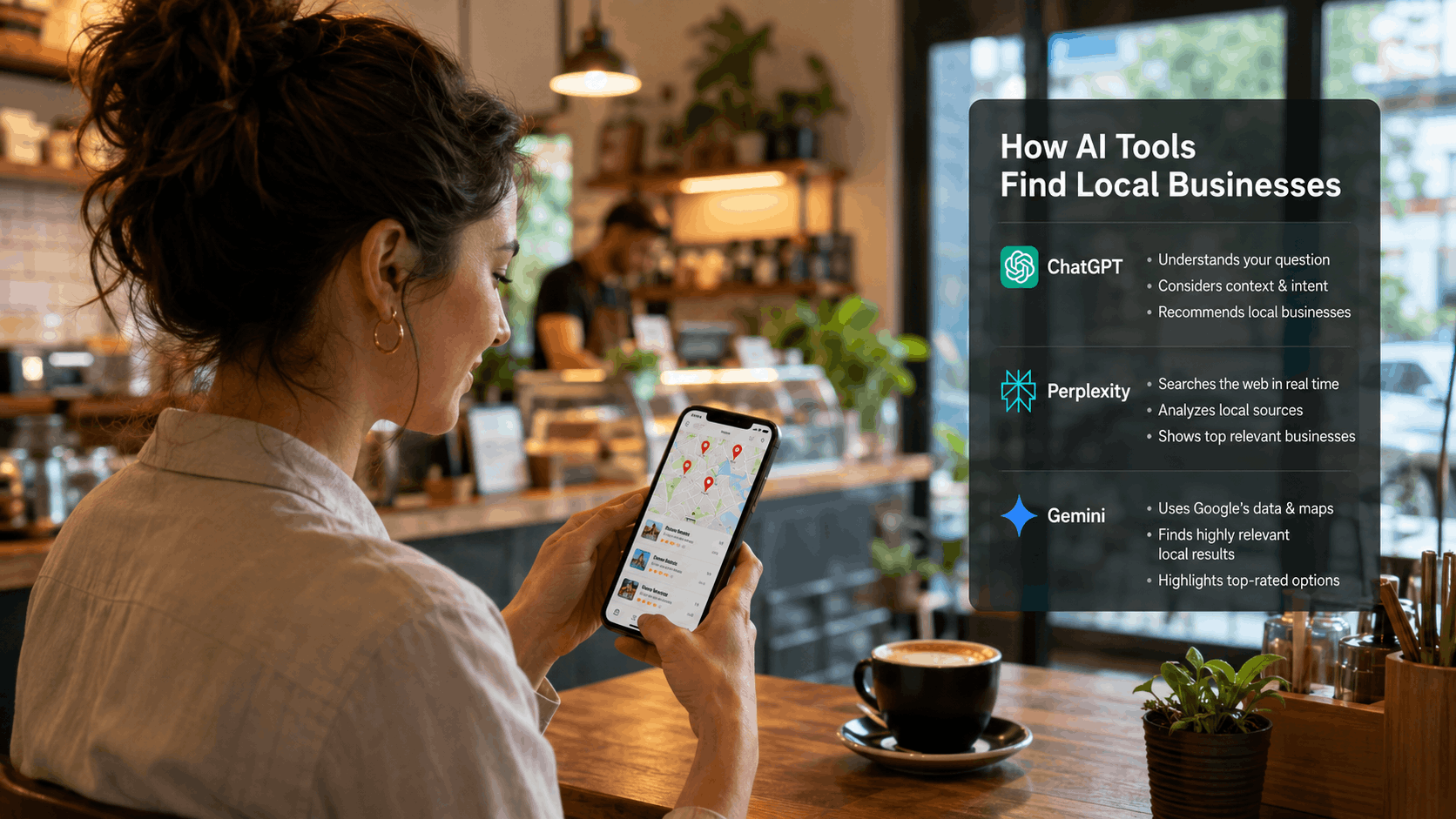
AI models learn from large amounts of text during training, but that knowledge has a cutoff date and is often thin or outdated for small local businesses. For local questions, the major tools increasingly search the web in real time and then summarize what they find. That is good news: current, accurate information on your website and listings can show up in answers without waiting for a model to be retrained.
Citations and linked sources
Many AI answers include links to the pages they used. Being one of those linked sources can bring visitors who already have context about you. Pages that answer specific questions clearly, with facts stated in text, are easier for AI tools to cite.
How ChatGPT Finds and Recommends Local Businesses
When ChatGPT searches the web
OpenAI's ChatGPT search help page says that when ChatGPT searches the web it can use your approximate location to find local results, sometimes works with third-party search providers, may show a map on phones and uses partners such as OpenTable, Resy and Yelp for restaurant information and bookings. It shows links to sources. OpenAI says "placement is not guaranteed."
How it decides which businesses to name
OpenAI does not publish how ChatGPT ranks local businesses. In practice, it summarizes what its search finds, so businesses with clear websites, consistent listings and a strong review presence on the sources it uses have a better chance of appearing. Results vary by location, wording and account settings.
Do not block ChatGPT's search crawler
OpenAI says sites that block its OAI-SearchBot crawler "will not be shown in ChatGPT search answers," according to its overview of OpenAI crawlers. Blocking a different crawler, GPTBot, only opts your content out of model training. If you or your web developer added rules to block AI bots, check that you have not blocked search crawlers you actually want.
Common mistakes that keep a business hidden in ChatGPT
- No website, or a website that never says which town you serve.
- Services hidden in images or PDFs instead of text.
- Blocking OAI-SearchBot by accident.
- Few or no reviews on the platforms it uses, such as Yelp for restaurants.
- Different hours or phone numbers across listings.
How Perplexity Surfaces Local Businesses
A search engine that answers with sources
Perplexity works like an answer engine: it searches the web for each question and writes a response with numbered citations to the pages it used. For local questions, that means it leans heavily on what it can find and read on the web right now: business websites, directories, review sites, local news and community pages.
How reviews and mentions shape its picks
Because Perplexity cites what it finds, businesses that are mentioned positively in several places, such as review sites, local "best of" lists, news stories and community forums, have more chances to be found and cited. Perplexity does not publish how it weighs these sources, so treat this as a sensible expectation rather than a rule.
Getting your site quoted
Pages that answer a specific question directly near the top, use clear headings and state facts in text are easier for any answer engine to quote. A service page that begins "We repair and replace residential roofs in Tulsa, Broken Arrow and Owasso, including hail and wind damage inspections" gives an AI tool a clear, quotable fact. A page that begins "Welcome to our website" does not.

How Gemini Connects to Google Data
Gemini and Google Maps
Gemini is Google's AI assistant, and Google has connected it to its own search and Maps information. In October 2025, Google announced that apps built on the Gemini API can use live Google Maps data on "more than 250 million places," including addresses, hours, ratings and user reviews, according to its announcement. That announcement is about apps built on Gemini, not a full description of how the Gemini app ranks businesses, but it shows how closely Google's AI and Maps data are tied.
Google AI Overviews and AI Mode
In Google Search itself, AI Overviews and AI Mode may run several related searches at once and link to pages already in Google's index, according to Google's guide to AI features and your website. Google says there are "no additional requirements" to appear and specifically tells businesses to keep their Business Profile information up to date.
How location and hours affect answers
For local questions, Google's AI and Maps features naturally lean on location data: where the business is, where the person is, what areas it serves and whether it is open. Google names relevance, distance and prominence as the main local ranking factors and says businesses "with complete and accurate info are more likely to show up in local search results," according to its help page on local ranking. Accurate hours, categories and service areas on your profile matter for both regular and AI results.
Why consistent information wins
When your website and Business Profile say the same thing, Google's systems have no conflict to resolve. When they disagree, such as a different phone number or old hours, AI answers can show the wrong details. Google also notes AI responses may include mistakes, according to Google Search Help, which is one more reason to keep sources clean.
Other AI Assistants and Where They Look
Microsoft's Copilot draws on Bing, and Apple's assistants and Maps draw on Apple's place data. Bing Places for Business is free, moved to bing.com/forbusiness in October 2025 and can import Google Business Profile data, according to Search Engine Journal; deeper links between Bing Places and Copilot were described as planned. Apple Business replaced Apple Business Connect in April 2026 as a free service for managing how your business appears in Apple Maps, Safari and Spotlight, according to Apple. Claiming these free listings covers more of the places AI assistants may look.
The Tools Side by Side
| ChatGPT search | Perplexity | Google AI Overviews and Gemini | |
|---|---|---|---|
| How it finds information | Searches the web when needed, can use approximate location, works with some third-party providers | Searches the web for each question | Draws on Google Search, its index and Google's place data |
| Shows sources | Yes, with links | Yes, numbered citations | Yes, supporting links |
| Local data partners mentioned publicly | Yelp, OpenTable, Resy for restaurants | Not specified here | Google Maps and Business Profiles |
| Crawler to allow | OAI-SearchBot | Perplexity's crawler | Googlebot |
| Paid placement in local answers | No | No | No |
The details change often, and each company adds features regularly. The common thread does not change: clear, accurate, consistent public information about your business.
The Questions People Ask AI About Local Businesses
It helps to think about the actual questions customers type or say. Some common patterns:
- Finding: "Who's a good electrician near me?" "Best family dentist in Boise?"
- Qualifying: "Which roofers in Tulsa do insurance claims?" "Is there a vet open Sunday near me?"
- Comparing: "Compare the top three pool services in Scottsdale."
- Checking: "Is [your business] any good?" "What do people say about [your business]?"
- Learning: "How much does it cost to replace a water heater?" "How often should I service my AC?"
Your website can help with all five: service and town pages for finding, clear details such as hours, insurance and specialties for qualifying, reviews for comparing and checking, and honest guides for learning.
What AI Tools Look For Before Recommending a Business
Clear, plain-language descriptions of services
State what you do in the words customers use. "We clean carpets, rugs and upholstery for homes and offices in Overland Park and Olathe" is far more useful than "premium cleaning solutions." Give each main service its own page, and put a short, direct summary at the top.
Strong location signals
Name the towns and neighborhoods you serve, with real local detail on each town page. Google's spam policies treat near-identical pages that only swap the town name as doorway pages, so make each page genuinely useful. Your address or service area should match on your site and every listing.
Reviews, reputation and repeated mentions
BrightLocal's 2026 survey found 47% of consumers won't use a business with fewer than 20 reviews and 74% want reviews from the past three months. Google lists review count and ratings as part of prominence, and AI tools built on Google's data have access to ratings and reviews. Ask every customer for a review the same way, and never buy reviews: the FTC's 2024 rule bans fake reviews, including AI-written ones.
A readable website AI tools can reach
Keep important information in text, not only in images or PDFs. Make sure search crawlers are not blocked. Google's guide lists the basics: allow crawling, make content findable through internal links, keep important content in text and verify your site in Search Console. Google also says you do not need special AI files or markup to appear in its AI features.
What Is GEO, and Does a Local Business Need It?
Generative engine optimization, or GEO, is a newer name for making your content easy for AI tools to find, understand and cite. You will also hear terms like AEO (answer engine optimization) and "AI SEO." For large publishers and national brands, GEO can involve detailed research into how different AI models cite sources. For a local business, it mostly comes down to the basics:
- A clear website that states your services, service area, hours and contact details in text.
- A page for each main service and town, with direct answers to common questions.
- A complete, accurate Google Business Profile and matching listings elsewhere.
- Steady, genuine reviews.
- Nothing blocking the search crawlers you want.
Google says plainly that there are "no additional requirements" to appear in its AI features and no special optimizations needed. Be skeptical of anyone selling a secret GEO formula for a local business. The fundamentals are the formula.
That does not mean GEO is useless as an idea. It is a helpful reminder to write for questions, not just keywords, to state facts plainly and to keep every source about your business consistent. Those habits make your website better for customers whether or not AI is involved, and they are the same habits that help you in regular Google results and the map.
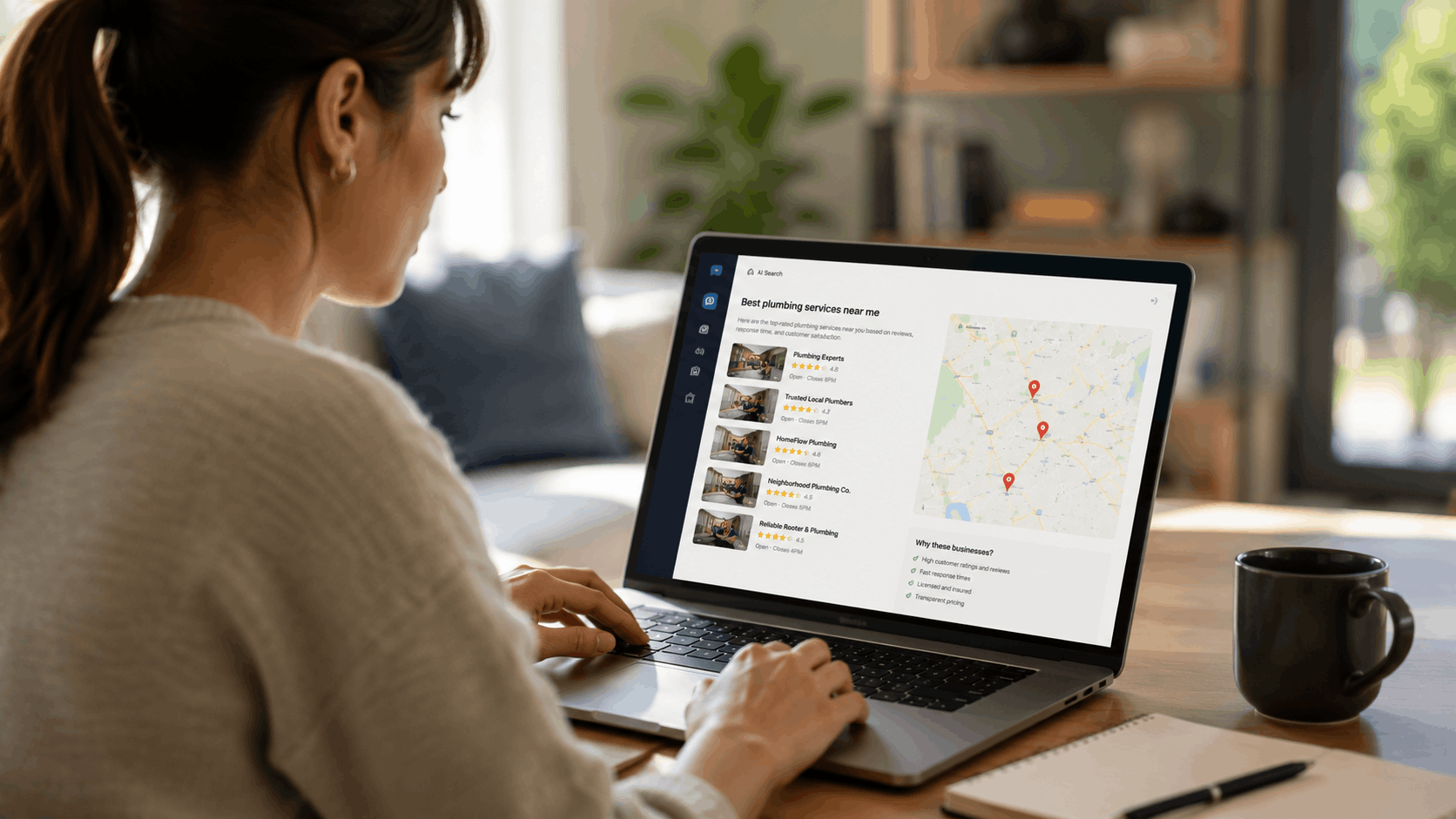
How a Local Business Can Show Up in AI Answers
Step 1: Build a website that states the facts clearly
Your homepage should say, in the first few lines, what you do, where you do it and how to reach you. Every service page should start with a short, direct summary. Put your phone number, service area and hours in text on every page, typically in the header or footer. Avoid hiding key facts in images, sliders or downloadable files.
Step 2: Write pages around real customer questions
Write down the questions customers ask on the phone and answer them on your site: how much does it cost, how long does it take, do you serve my town, are you licensed and insured, what happens during a visit. These are the same kinds of questions people ask AI tools. Clear answers on your site give those tools something accurate to use. Google's SEO Starter Guide asks for content that is "helpful, reliable, and people-first."
Step 3: Keep listings and site details matching
Use the same business name, phone number and address or service area on your website, Google Business Profile, Apple Business, Bing Places, Yelp, Facebook and the directories that matter in your industry. Use your real business name. Google's guidelines for representing your business say adding extra words such as keywords to your name is not permitted. After any move, phone change or rebrand, update every listing.
Step 4: Build a steady review habit
Ask every customer for a review, the same way, right after the job, with a direct link. Reply to every review. Google bans incentives for reviews, asking only happy customers and, since April 2026, asking for specific content such as a staff member's name. For copy-and-paste scripts, see our guide to getting your first 25 Google reviews.
Step 5: Check that AI search crawlers can reach your site
Ask your web developer or website builder whether your site blocks any search crawlers. OpenAI's OAI-SearchBot is needed for ChatGPT search. Googlebot is needed for Google Search, including its AI features. Blocking training-only crawlers is a separate choice that does not affect search visibility in the same way.
Step 6: Check what AI says about you every month
- Ask ChatGPT, Gemini, Perplexity and Google about your business by name.
- Ask for your main service plus your town, the way a customer would.
- Note whether you are named, what details are shown and which sources are linked.
- Fix wrong facts at the source first: your website and listings.
- Use feedback tools: the thumbs down and "Report a problem" on a Google AI Overview, and the thumbs down under a ChatGPT response.
Answers vary by location, wording and account, and they change over time. Look for patterns over months rather than reacting to one answer.
Before and After: A Page AI Can Actually Use
Before: "Welcome! We are a family-owned company committed to excellence. Our team provides top-quality solutions for all your needs. Contact us today!"
After: "We install and repair furnaces, heat pumps and central air for homes in Lexington, Nicholasville and Georgetown, Kentucky. Most repair visits are scheduled within one to two business days. Call us or request a visit online. We're licensed and insured, and we give a written price before starting any work."
The second version answers what, where, how fast, how to book and why to trust you in four sentences. A person can decide in seconds, and an AI tool can extract accurate facts and cite them. Every claim in it should be true for your business, of course; only write what you can deliver.
Other Signals Worth Getting Right
Structured data
Structured data is code that describes your business to search engines. Google's LocalBusiness documentation requires only name and address, and the details must match what is visible on your page. Google says no special structured data is needed for its AI features. It can help search engines understand your details, but it is not a shortcut to AI recommendations.
Real photos
Photos of your team, vehicles, storefront and work make your profile and website more trustworthy to customers checking you out after an AI mention. Nielsen Norman Group's eyetracking research found users ignore generic stock photos but look closely at real ones. Use descriptive file names and alt text so the content of each photo is also stated in text.
Local mentions beyond your own site
AI tools that search the web may find you through local news coverage, chamber of commerce listings, community event pages, sponsor lists, local "best of" features and neighborhood forums. Genuine community involvement creates these mentions naturally. Google's spam policies describe buying links that pass ranking credit as link spam, so focus on real relationships rather than paid placements.
Tracking visits from AI tools
Google says traffic from its AI features counts in your Search Console Performance report under the "Web" search type, not in a separate report. Visits from other AI tools often show up in your website analytics as referrals from their domains, such as chatgpt.com or perplexity.ai. Ask new customers how they found you, too. Many will simply say "Google" even if an AI tool started the search, so treat any single number as a rough guide.
How AI Answers Differ by Type of Business
Urgent services
For "tow truck near me" or "locksmith open now," AI tools and Google lean heavily on location, hours and map data. Accurate hours, a clear phone number and a complete Business Profile matter most.
Planned home services
For "best roofer for hail damage in Tulsa" or "how much does a kitchen remodel cost," AI tools draw more on websites, reviews and guides. Detailed service pages, honest pricing information and recent reviews help.
Health and professional services
For dentists, chiropractors, lawyers and accountants, AI tools often draw on practice websites, directories and reviews. Accurate, careful content written or reviewed by the professional, consistent directory listings and genuine reviews matter, along with your profession's own advertising and privacy rules.
Service-Area Businesses and AI Answers
Many local businesses, such as plumbers, cleaners, roofers and mobile groomers, travel to customers and hide their address on Google. That is fine and follows Google's guidelines, but it means AI tools have less location data to work with. Make up for it by clearly listing the towns and neighborhoods you serve on your website, building a page for each main town with real local detail and setting your service areas accurately on your Business Profile. When someone asks for "a carpet cleaner in Olathe," the tool needs some way to know you go there.
Three Example Businesses
A roofer who is invisible in ChatGPT
A roofing company with good Google reviews asks ChatGPT for roofers in its town and is never named. Its website is a single page with a slideshow, and the services are listed in an image. The owner rebuilds the site with a page for each service and town in plain text and confirms the site does not block search crawlers. A couple of months later, ChatGPT starts linking to the company's storm damage page in some answers.
A dental office with conflicting hours
A dental office changed its Friday hours, but only on its website. Google's AI Overview and several directories still show the old hours, and patients arrive to a locked door. The office manager updates the Business Profile, Apple Business, Bing Places, Yelp and two health directories. Within weeks, AI answers show the right hours.
A pet groomer with few reviews
A pet groomer has a clear website but only six reviews. When asked for groomers nearby, AI tools name competitors with more reviews. The owner starts texting every customer a review link after each appointment. As reviews build, the groomer begins appearing more often in both the map results and AI answers, though never every time.
Why Small Local Businesses Can Win
Large chains and franchises often have generic local pages: the same text with a different city name, a corporate phone number and stock photos. A small local business can be far more specific: the owner's name and story, the neighborhoods it actually serves, real photos of its own team, a local phone number that someone answers, honest pricing and reviews from neighbors. Those specifics are exactly what make information useful to customers and to AI tools summarizing it. Being local and specific is not a disadvantage in AI search. It is often the edge, and it costs nothing but honesty and attention to detail.
Common Mistakes Across All AI Tools
- A vague homepage that never says what you do or where.
- Key facts in images or PDFs instead of text.
- Outdated listings with old hours, phone numbers or addresses.
- A keyword-stuffed business name on Google, which can get your profile suspended.
- Copied town pages that only swap the town name.
- Blocking search crawlers by accident.
- Ignoring reviews or letting them go stale.
- Chasing tricks instead of fixing the basics.
A Monthly Routine
- Ask two or three AI tools about your business and your main service plus town, and note the results.
- Check your Google Business Profile and main listings for accuracy.
- Ask every customer for a review and reply to every review.
- Add new photos to your website and profile.
- Review Search Console for pages with impressions but few clicks, and improve their titles and opening lines.
Common Myths About AI and Local Search
"You have to pay AI tools to get listed"
ChatGPT, Perplexity, Gemini and Google's AI features do not sell local recommendation slots. OpenAI says placement is not guaranteed, and Google says there is no way to pay for a better local ranking.
"Only big brands get recommended"
AI tools often recommend small local businesses when the information about them is clear, consistent and well reviewed. Being specific and local is an advantage.
"AI search replaces Google"
Not for local businesses yet. In DreamHost's 2026 survey, only 3% of US adults said they start a local search with AI, and many check Google after an AI recommendation.
"You need an llms.txt file or special AI markup"
Google says you do not need new machine-readable files, AI text files or special markup to appear in its AI features. Other tools have not said such files are required for local recommendations either.
"AI knows everything about my business already"
AI tools only know what they can find. If your information is thin, outdated or inconsistent, their answers will be too.
What Not to Waste Money On
- Guaranteed AI placement packages. No one can guarantee what an AI tool says.
- Bulk directory submissions to hundreds of low-quality sites. Focus on the listings customers actually use.
- Fake or purchased reviews. They break Google's policy and the FTC rule.
- Mass-produced AI content with no real local detail. Thin, copied pages help no one.
- Special AI files sold as a ranking secret. Google says they are not needed for its AI features.
A 30-Day Plan
Week 1
- Verify and complete your Google Business Profile: category, services, service area, hours, photos.
- Claim Apple Business, Bing Places and Yelp, and make your details match.
Week 2
- Rewrite your homepage opening to say what you do, where and how to reach you.
- Make sure each main service and town has its own page with a direct summary at the top.
Week 3
- Add answers to your five most common customer questions.
- Confirm with your web developer or builder that search crawlers are not blocked.
- Start asking every customer for a review.
Week 4
- Ask ChatGPT, Gemini, Perplexity and Google about your business and note what they say.
- Fix any wrong details at the source.
- Set a monthly reminder to repeat the check.
How Grow Local Helps
Grow Local is a website builder for local business owners with no technical skills, covering 104 industries. You answer simple questions about your services, the towns you serve, your hours and branding, and AI builds 50 or more pages, including service pages and a location page for each town you serve, with your business details entered once and used site-wide. It includes hosting, SSL, a custom domain, a mobile-responsive design and a Google Business Profile connection. It costs $99 a month on one plan, with no contract, and you can preview the full site free before paying. It cannot guarantee rankings or AI recommendations, because no one can. You still need reviews, accurate listings and a review of every AI-written page for accuracy.
Frequently Asked Questions
Can ChatGPT recommend my local business?
Yes. When ChatGPT searches the web, it can find and name local businesses and link to them. OpenAI says placement is not guaranteed. A clear website, consistent listings, genuine reviews and not blocking OAI-SearchBot all help.
Do I need a website to show up in AI answers?
It is not strictly required, since AI tools also use listings and reviews, but it helps a lot. Yext's 2025 analysis found first-party websites were the largest single source of AI citations at 44%.
How is Perplexity different from ChatGPT for local search?
Perplexity is built around live web search with cited sources for every answer. ChatGPT searches the web when needed and uses partners for some local data, such as Yelp for restaurants. Both reward clear, accurate information that is easy to find.
Does Gemini use my Google Business Profile?
Google has tied its AI tools closely to its Maps and place data, and its AI features guide tells businesses to keep Business Profile information current. Keep your profile complete and accurate.
What is GEO for local businesses?
Generative engine optimization means making your information easy for AI tools to find and cite. For local businesses, it is mostly clear service and town pages, accurate listings, genuine reviews and crawlable pages.
How long does it take to show up in AI tools?
It varies. Tools that search the web live can pick up new information as soon as they find it, but it can take weeks or months for changes to be crawled and reflected consistently. No one can promise a timeline.
Can I pay to appear in ChatGPT or Gemini answers?
No. Local recommendations are not sold. Be wary of anyone claiming to guarantee placement.
What should my website include for AI?
Your services, the towns you serve, hours, phone, address or service area, pricing information where possible, answers to common questions and real photos, all in text that crawlers can read.
Do reviews affect AI recommendations?
Reviews are part of the public information AI tools can draw on, and Google lists them as part of local prominence. No tool publishes exactly how it weighs them.
What should I do if an AI tool says something wrong about my business?
Fix the information at the source first: your website, Google Business Profile and other listings. Then use the tool's feedback option, such as the thumbs down and "Report a problem" on a Google AI Overview or the thumbs down under a ChatGPT answer. Feedback does not guarantee a change, but accurate sources make correct answers more likely over time.
Should I block AI crawlers to protect my content?
That is your choice, but be careful. Blocking search crawlers such as OAI-SearchBot or Googlebot can keep you out of those tools' answers. Blocking training-only crawlers such as GPTBot is a separate decision that OpenAI says only affects model training.
Do AI tools treat service-area businesses differently?
They have less address data to work with when your address is hidden, so clearly list the towns you serve on your website and Business Profile, with a page for each main town.
Will AI search replace Google Maps?
Not anytime soon for local businesses. Most people still use Google and Maps to find and check local businesses, often after an AI recommendation.
Final Thoughts
AI tools find local businesses by reading what is already out there: your website, your listings, your reviews and mentions across the web. None of them sells placement, and none rewards tricks. The businesses that show up are the ones that make the facts easy to find: what they do, where, when they are open and why customers trust them. Build clear service and town pages, keep every listing accurate, earn reviews steadily, make sure crawlers can reach your site and check what AI says about you once a month. That work helps in Google, in Maps and in every AI tool at the same time. It does not require a big budget or technical skills, just steady attention, a few hours a month and honest information that matches everywhere your business appears online. For a deeper look at one tool, see our guide to getting your business recommended by ChatGPT.